The Circular Advantage: How Refurbished Phones Became a C-Suite Strategy for 2026

What if your company's next competitive edge wasn't a new software, but a smarter way to source hardware?
As 2026 approaches, executive priorities are being reshaped by a perfect storm: stringent ESG mandates, relentless supply chain pressure, and investors who now scrutinize operational sustainability as closely as the P&L. In this new reality, a potent strategy is emerging from an unexpected corner—the corporate mobile fleet.
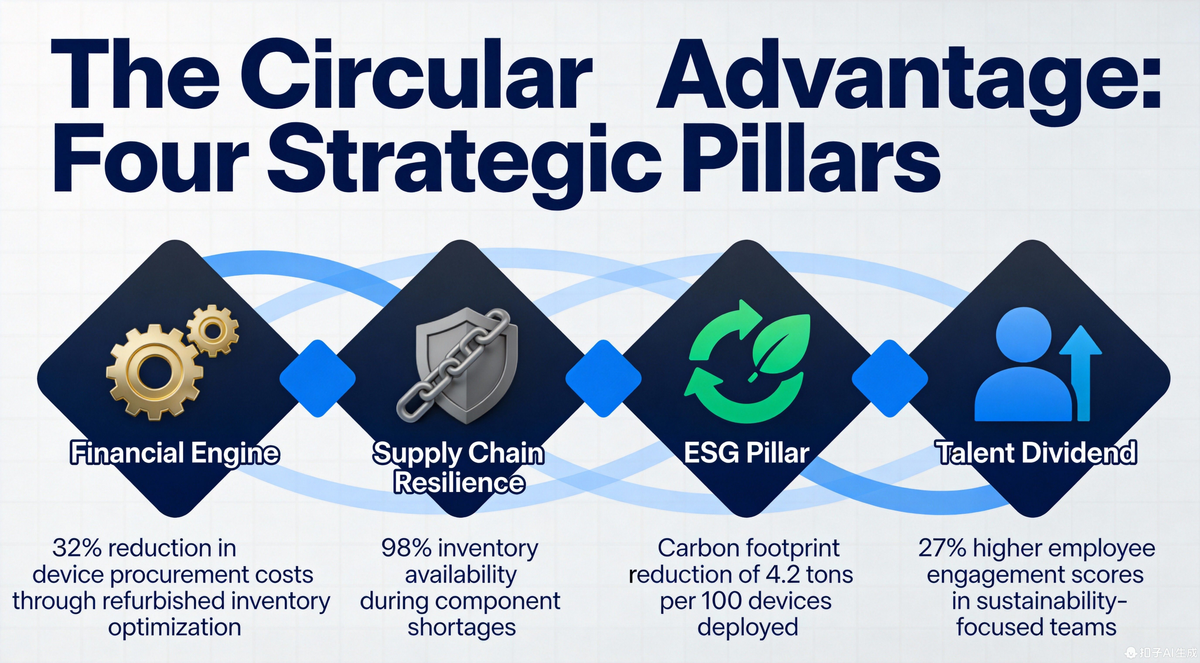
Procuring B2B refurbished smartphones is undergoing a radical shift. It's no longer just a tactical cost-cut for IT. By 2026, it will be a core, cross-functional strategy—what we call The Circular Advantage. This approach delivers measurable wins across financial resilience, ESG compliance, risk mitigation, and talent, directly impacting both your bottom line and your brand.
Let's break down the four pillars of this advantage and how to implement it.
1. The Financial Engine: Seeing Beyond the Sticker Price
Yes, the upfront savings of 40-70% are compelling. But the real story for the CFO unfolds over time.
- Budget Certainty: It insulates you from the volatile pricing of new flagship launches and the inflationary swings in electronics.
- Lower Overhead: A reduced asset value on the balance sheet can mean lower insurance premiums and liability.
- Capital Recovery, Not Just Depreciation: Leading B2B partners offer structured buy-back programs. This turns a depreciating asset into a source of recoverable capital, creating a circular cash flow.
- The Bottom Line: Look at the 3-year Total Cost of Ownership for a fleet of 500 devices. When you factor in purchase price, resale value, and lower overhead, the circular model doesn't just save money—it builds a more efficient and predictable financial model for hardware.
2. The ESG Pillar: From Pledge to Practice
For the CSO and leadership team, sustainability must move from report to reality. Refurbished procurement is a direct, high-impact lever.
- Cut Embodied Carbon, Drastically: Up to 80% of a smartphone's carbon footprint is locked in during manufacturing. Extending a device's life is one of the most effective ways to slash your Scope 3 emissions.
- Turn E-Waste into a Win: It delivers tangible progress against "zero waste" goals, directly addressing the global e-waste crisis.
- Build Compliance, Not Just Reports: This strategy generates the concrete data you need for frameworks like the CSRD, SEC climate rules, and UN SDGs.
- Tell a Better Story: It’s a demonstrable, quantifiable action that shows investors you're operationalizing your commitments, not just announcing them.
3. Building Supply Chain Resilience
For the CSCO and CIO, geopolitical tensions and logistical fragility make linear supply chains a single point of failure. The circular model builds buffers.
- Reduce Single-Point Dependency: Sourcing from a distributed, circular network lessens reliance on distant manufacturing hubs and congested shipping lanes.
- Ensure Business Continuity: Access a ready inventory of quality devices for new hires or replacements—even during the next chip shortage or product delay.
- Standardize Security: A certified B2B partner delivers a uniform, warrantied, and secure fleet. Every device undergoes certified data erasure (e.g., NIST 800-88), eliminating the risks of the informal market and ensuring ironclad compliance.
4. The Talent Dividend: When Operations Reflect Culture
For the CEO, culture is currency. A purpose-driven operational model resonates deeply with today's workforce.
- Attract and Retain: A significant majority of employees, especially younger generations, prefer to work for environmentally responsible companies. This is a tangible proof point of your values.
- Empower, Don't Mandate: Offer high-quality, recent-model refurbished devices as a premium, green choice. When the experience is seamless and the device is indistinguishable from new, adoption follows.
- Create Brand Ambassadors: This initiative provides a powerful narrative for internal comms, turning a procurement policy into a story of responsibility that employees can own and share.
Your Playbook for 2026
Realizing the Circular Advantage demands cross-functional leadership and disciplined execution.
Step 1: Break Down Silos
This isn't an IT-only decision. Form a task force with leaders from Finance (CFO), IT/Procurement (CIO), Operations (CSCO), and Sustainability (CSO).
Step 2: Vet Partners, Not Just Vendors
Your B2B refurbisher must be a strategic ally. Your checklist should include:
- Transparent Grading: Clear, industry-standard quality tiers (e.g., "Like-New," "Premium").
- Certified Data Security: Non-negotiable, auditable data-wiping processes for every single device.
- True B2B Services: Bulk pricing, centralized billing, custom provisioning (kitting), and dedicated account management.
- Enterprise-Grade Support: Warranties that meet or beat OEM terms, with clear SLAs for support and replacement.
Step 3: Pilot, Prove, and Scale
Start with a controlled pilot—like equipping all new hires in Q1 or a specific department. Measure cost savings, user satisfaction, and operational ease. Use this data to build the compelling case for an enterprise-wide rollout.
Conclusion: Future-Proofing Your Fleet
By 2026, harnessing the Circular Advantage in IT procurement will be a hallmark of resilient, responsible leadership. It’s a multi-faceted strategy that answers the core demands of our time: building agile operations, demonstrating genuine stewardship, and empowering your people.
Your Move: Task a cross-functional team with reviewing your current mobility strategy. Evaluate it not as a line-item cost, but through the lenses of financial efficiency, ESG impact, supply chain risk, and talent.
Shifting to a circular model for mobile devices is more than a procurement update. It's a blueprint for transforming hardware from a cost center into a strategic advantage.
Myth Busting: Straight Talk for the C-Suite
- "Aren't they less reliable?" Professional B2B refurbishers subject devices to rigorous testing and repair, often achieving failure rates lower than new devices. Comprehensive warranties back this up.* "Is our data safe?" Reputable partners use certified, auditable data erasure standards (like NIST 800-88) that permanently destroy all data. This process is often more rigorous than typical in-house device retirement.* "Will our team push back?" Today's premium refurbished devices are cosmetically and functionally identical to new. By framing them as a premium, sustainable choice—and offering recent models—you align with employee values and often see higher satisfaction.